
Fragrance Production Timelines: Planning Lead Times for a Small Order
A fragrance production timeline is built backward from the shelf date, and most of the elapsed time is not production at all. Briefing, development rounds, stability testing, decoration, packing and transit each eat calendar days, and a small order has the same number of phases as a large one. The brands that miss their launch date are usually the ones that budgeted only for the manufacturing weeks and hoped the rest would compress.
Key takeaways
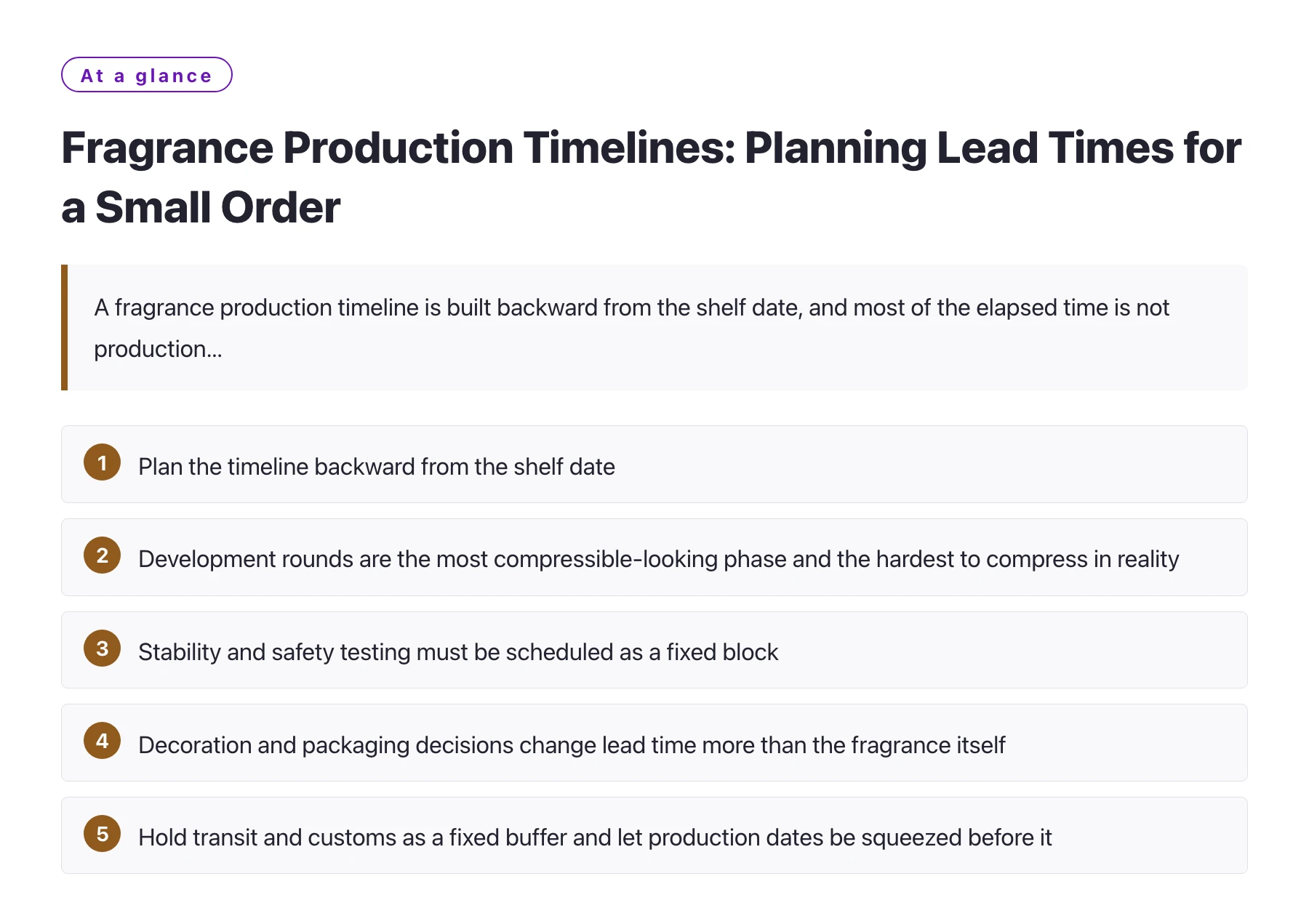
- Plan the timeline backward from the shelf date; the phases before and after production usually consume more calendar time than the production itself.
- Development rounds are the most compressible-looking phase and the hardest to compress in reality; freeze the brief before the clock starts.
- Stability and safety testing must be scheduled as a fixed block, because a shortened test is not a shorter timetable; it is a different product.
- Decoration and packaging decisions change lead time more than the fragrance itself, so lock artwork and materials early.
- Hold transit and customs as a fixed buffer and let production dates be squeezed before it, never after.
This article approaches the timeline the way an operations lead would: as a chain of phases, each with an owner and a duration, rather than as a single manufacturing event. The reader is assumed to have a target launch or shelf date, and the goal is a plan in which the last phase ends exactly at that date.
The phases below are generic to fragrance OEM/ODM production, which is deliberate: the value is in the structure, not in a specific factory's promises. The timeline table summarises the phases and the buffers, and the closing section covers how to contract a timeline so that it survives contact with reality.
The phases, in order
- Freeze the briefScent direction, format, size, price band and target market written down before suppliers are approached, so comparisons start from one document.
- Run development and samplingTranslate the brief into trials and iterate to approval; each round adds days, so agree the round structure and the approval gate before starting.
- Schedule testing and stabilityReserve the full conditioning and testing block; the testing plan must match the destination market, not the most convenient option.
- Lock decoration and packagingConfirm bottles, caps, artwork and cartons with their tooling and production times; this is usually the least elastic part of the schedule.
- Produce and fill the batchThe visible manufacturing phase; its duration depends on the line and the volume, but it is rarely the longest phase in the calendar.
- Leave the transit and customs bufferHold shipping and clearance as a fixed block, and let everything before it be squeezed, never the other way around.
Where the calendar actually goes
| Phase | Typical character | The mistake that stretches it |
|---|---|---|
| Briefing and negotiation | Negotiable, compressible early | A vague brief that causes rework everywhere after |
| Development and sampling | Iterative, multiple rounds | Approving samples informally instead of against a written gate |
| Testing and stability | Fixed duration, cannot rush | Scheduling tests around production instead of the reverse |
| Decoration and packaging | Tooling and material dependent | Choosing artwork or packaging after production is booked |
| Production and filling | Relatively predictable | Expecting the factory's peak season to behave like low season |
| Transit and customs | External, little control | Treating shipping time as optional rather than a fixed buffer |
The pattern is that the compressible phases need discipline and the fixed phases need respect. Most timeline failures come from compressing the fixed ones and being lax with the compressible ones.
Why a small order is not faster than a large one
The instinct of many first-time buyers is that a small order should move faster because there is less to make. The reality is different: the phases that consume calendar time - development, testing, decoration, transit - are mostly volume-independent. A small batch is not rushed through stability testing, and a small order does not skip customs.
The honest implication is that a small first order deserves the same timeline planning as a serious launch, and its advantage is not speed but flexibility: at small volume, the buyer can pick suppliers and dates with less pressure, and recover from a delay with a smaller financial consequence. Brands putting their first run together often browse the reference material published by established manufacturers, such as the planning pages on Xuelei Perfumes, before committing to a supplier's quoted calendar.
The testing block decides the honest date
The single most misplanned phase is stability and safety testing, because it looks soft from outside and is completely fixed from inside. Testing aligned with cosmetics GMP practice covers the checks that determine shelf life and market acceptance, and skipping or shortening it does not compress the calendar; it changes what the product can legally claim [1]. The trade press regularly reports launch difficulties that trace back to a testing or regulatory phase that was scheduled too late [2].
The planning rule is to fix the testing window first, then place production before it and transit after it. Any supplier who suggests the tests can be squeezed into a shorter window than the destination market expects should be asked exactly what is being dropped, because the answer defines the product.
Aligning the test plan with the market
Different destinations expect different evidence, and the plan should be agreed with the manufacturer at sampling time, not discovered at the end. A supplier with export experience will lay out the test options and their durations without being pushed; that willingness is itself a schedule signal worth noting during selection.
When the launch date slips anyway
A realistic timeline has two buffers: one inside the development phase and one before the final transit cut-off. When something slips, absorb it in the early buffer. If both buffers are gone and the date still moves, the professional move is to move the launch date early and visibly rather than tighten testing. A slipped date is recoverable; a product that skipped its validation is a different category of problem.
Write the timeline as a table of phases, owners and dates, and update it at every project meeting. The discipline is not the chart; it is that every phase has a named owner and a named end date, so a delay shows up the week it happens, in a place where someone is responsible.
Contracting the timeline so it survives
The timeline should be an attachment to the agreement, not a shared hope. For each phase, the buyer should have a commitment to the end date, the owner, and what happens if the date moves: who communicates, in what time, and with what recovery plan. Suppliers that plan their own calendar transparently at the negotiation stage tend to be the same ones that manage it honestly during production.
The tools for keeping a timeline honest are the same regardless of supplier size: written phase dates, a change-control habit, and a buffer held in reserve. A manufacturer that runs development, decoration, filling and documentation in one place shortens the coordination tail of the timeline, which is why one-stop fragrance manufacturing is a live argument in schedule planning, not a marketing label. When a buyer evaluates such a supplier's service, the question to ask is whether the published scope matches the phases in the timeline - in other words, whether the role of a Xuelei covers everything the plan depends on, or only the parts that look good in a brochure.
Finally, the buyer's own calendar matters as much as the factory's. Approvals, artwork, payments and document replies all take the buyer's days, and every day the buyer takes to decide is a day added to the supplier's schedule. A timeline that fails usually fails at that hand-off, between the brand's decision meeting and the factory's next phase.
Sources
- SGS: Cosmetics, Personal Care & Household Testing —— Testing, inspection and certification services for cosmetics and personal care, including microbiological, stability and safety testing aligned with cosmetics GMP.
- Cosmetics Business —— A trade publication covering the beauty and cosmetics industry, including fragrance launches and regulatory developments.
Frequently asked questions
How long before launch should I start a fragrance production timeline?
Start from the launch date and count backward through testing, production, decoration and transit, then add the development phase and a buffer before it. Most first-time buyers discover the needed runway is far longer than they assumed, which is why starting early is cheaper than starting right.
Why is stability testing a fixed block instead of flexible time?
Because testing determines what the product can legally claim and how long it lasts on the shelf. The calendar can be rearranged around a fixed testing window; it cannot rearrange the testing window itself without changing the product.
Which phase most often delays a small fragrance order?
Development round approvals and decoration decisions are the usual culprits, because both depend on the buyer's responsiveness and on informal approvals that drift. Fix the approval gate and the artwork date in writing and the schedule mostly holds.
Can a small order be rushed through production?
The factory can often move a small batch forward, but the phases around production - testing, transit, customs - cannot be rushed the same way. Spend the goodwill on the fixed phases, not on the production week.
What is the difference between a lead time and a timeline?
A lead time is the supplier's quoted duration for one phase; a timeline is the whole chain from brief to shelf. Buyers who negotiate only lead times end up managing a chain that was never planned.
Grab a Seat at the Stage Rail
Reserve a table for dinner, lock in a private event, or check who's on stage next. The kitchen is open late and the amps are always warm.