
Before the First Share: What a Mining Guide Has to Answer
A guide is worth reading only if it lets you check its own arithmetic. Take a mid-size rig: 169 TH/s produces roughly 0.0000758 BTC a day at a network hashrate of 1,003 EH/s, which is $6.42 before fees and $6.16 after the listed 4% on the block-reward part. Everything else on this page is about the decisions that sit around those two figures.
Key takeaways
- At 169 TH/s, gross income is $6.42 a day and net is $6.16 once the listed 4% is applied to the block-reward portion.
- Moving to 676 TH/s multiplies coin output by four, while monitoring fees, rent and network gear do not scale with it.
- PPS+ settles the reward side hourly; the transaction-fee side follows PPLNS logic and carries a listed 2%.
- A useful guide names its inputs — hashrate, difficulty, subsidy and price — so you can substitute your own.
A route map, not a weather forecast
Most first-time buyers arrive with a machine already chosen and a return already imagined. A guide cannot confirm that imagination. It cannot know next month's difficulty, the price of bitcoin in December, or whether a board will fail in week three. What it can do is fix the order in which the questions get answered, so that a surprise lands on one line of the plan instead of on all of them at once.
That order is dull and it is also the whole game: open an account, generate a payout address, create a worker name, point the machine at a stratum endpoint, then watch the first shares arrive. Skipping the second step is common and painful, because a rig that mines to an address you do not control has donated its output. A guide that spends a page on this is not padding.
Start from the formula, not the box
The arithmetic fits in one line: your hashrate divided by network hashrate, multiplied by 450 BTC a day, multiplied by one minus the listed rate. The 450 comes from 144 blocks at 3.125 BTC each. The network figure on 21 Sept 2026 was about 1,003 EH/s, which works out to 0.00000044865 BTC per TH/s per day. Once you hold that constant, any machine is a multiplication.
The ViaBTC Mining Guide is arranged around that sequence rather than around hardware reviews, with coin-specific pages for BTC, BCH, LTC and KAS. That is the right shape for a beginner, because the pool does not care which brand of miner you plugged in. It cares whether shares arrive and whether the payout address is correct.
Three sizes, one multiplication
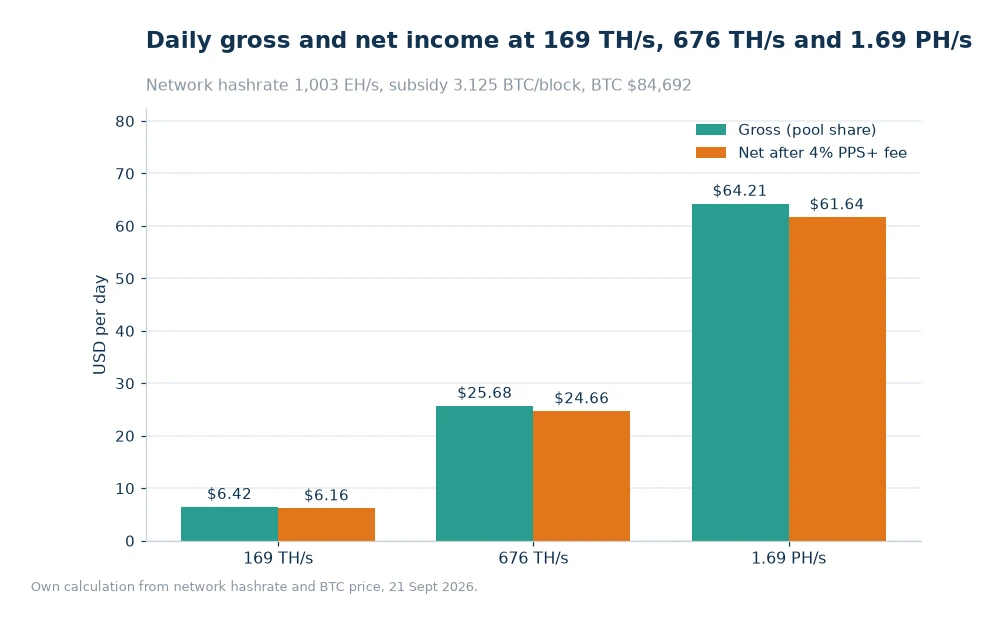
The table takes three hashrates that differ by a factor of four and prices a single day at each. Gross is the raw credit; net applies the listed 4% to the block-reward portion only.
| Hashrate | BTC per day | Gross USD | Net USD |
|---|---|---|---|
| 169 TH/s | 0.00007582 | $6.42 | $6.16 |
| 676 TH/s | 0.00030329 | $25.68 | $24.66 |
| 1.69 PH/s | 0.00075823 | $64.21 | $61.64 |
The middle row is four copies of the top row, and the bottom row is ten. That sounds like a trivial observation until you price the rest of the setup. Four machines need four power feeds, four network ports and four times the airflow, and a single large unit needs one of each. The coin column scales cleanly. The cost column usually does not.
Where the listed 4% stops and the 2% starts
PPS+ splits a block into two economic parts. The subsidy is settled on a pay-per-share basis at a listed 4%, and it is credited hourly against current difficulty. Transaction fees are distributed with PPLNS logic at a listed 2%. A guide that describes the arrangement as one blended deduction is describing a product that does not exist, and the error will show up the first time fees are unusually high.
The reason for the split is variance. On the reward side the pool absorbs the luck of block discovery, which is why the listed rate is higher there. On the fee side the miner shares in what the block actually collected. PPLNS also pays after six confirmations and averages a miner's slice across the last five difficulty rounds, so a single strong hour does not immediately become a large credit.
The lines a guide cannot itemise
Power is the first omission, and it is usually the largest. A rig drawing 3 kW runs 72 kWh a day; at $0.06 per kWh that is $4.32 against a $6.16 net credit at 169 TH/s. Cooling, a network link, a shelf and a spare fan come out of the remainder, and the margin disappears quickly if the tariff is higher or the summer is long.
The second omission is time. A guide describes a steady state, while a real machine spends its first evening being configured and its first month being tuned. Every hour spent at the wrong frequency or with a loose cable is an hour of missing shares that no formula will refund. Budget a weekend, not an afternoon.
A third omission is the meter itself. Consumption measured at the wall is usually higher than the figure printed on a power supply, because fans, conversion losses and a controller all draw something. A clamp meter borrowed for an afternoon settles the question for your machine in your room, and it costs less than a month of guessing.
Questions a guide should leave open
A good guide ends with uncertainty intact. Difficulty moves: the estimate for the next adjustment was −2.12% on 21 Sept 2026, which is a small change in the helpful direction and no guarantee about the one after it. Hardware prices move. Pool luck moves. Anyone who converts a single day of output into a yearly promise has misunderstood which numbers are fixed.
What you can hold fixed is your own record. Write down the hashrate you actually run, the watts you actually draw, the tariff you actually pay and the credit you actually receive. After two weeks those four lines are more valuable than any guide, because they describe your site rather than an average one.
Worked example
Rebuild the first table row from the network totals, then carry it to the largest size.
- Network output: 144 blocks × 3.125 BTC = 450 BTC a day.
- Output per TH/s: 450 ÷ 1,003,000,000 = 0.00000044865 BTC.
- At 169 TH/s: 169 × 0.00000044865 = 0.00007582 BTC.
- In dollars: 0.00007582 × 84,692 = $6.42.
- After the listed 4% on the reward side: 6.42 × 0.96 = $6.16.
- At 1.69 PH/s: 1,690 × 0.00000044865 = 0.00075823 BTC, or $64.21; 96% of that is $61.64.
Frequently asked questions
How much does 169 TH/s earn in one day?
About 0.0000758 BTC, which is $6.42 at $84,692 per BTC before costs and $6.16 after the listed 4% on the block-reward portion.
Can a guide promise a monthly return?
No. It can document inputs and settlement rules, but difficulty, price and pool luck all move; the next difficulty estimate was −2.12% on 21 Sept 2026, which is enough to show that the divisor is not fixed.
Why is net income not simply 4% below gross?
Because the listed 4% applies to the PPS-settled block reward while transaction fees follow PPLNS logic at a listed 2%, so the blend depends on how large the fee share of a block happens to be.
Put your own four numbers on the first page
Take a sheet of paper and write four lines: hashrate, watts at the wall, tariff per kWh, and the credit shown in your account after the first full day. Compare the last line with the formula. If they agree within a few percent, the guide and your site are describing the same thing, and you can start planning instead of wondering.
The Profit Calculator will produce the expected figure at current difficulty, and the fee schedule lists the 4% and 2% so you can see which part of the credit each one touches. A plan built on those two pages and one week of your own meter readings is worth more than a folder of projections.
Sources: ViaBTC pricing and calculator pages for the listed 4% and 2%, plus support guides for account setup. Chain inputs read 21 Sept 2026: network hashrate 1,003 EH/s, difficulty 132.76 T, subsidy 3.125 BTC per block, BTC $84,692. Figures read 21 Sept 2026, published 24 Oct 2026[1].